
Jeep Avenger Electric
Real-world range calculator with WLTP data
Specifications
Calculate Real-World Range
Real-world range calculator with WLTP data
Estimated range
Results are estimates based on WLTP data and standard correction factors. Real-world range may vary based on many factors.
How the Jeep Avenger Electric Range Calculator Works
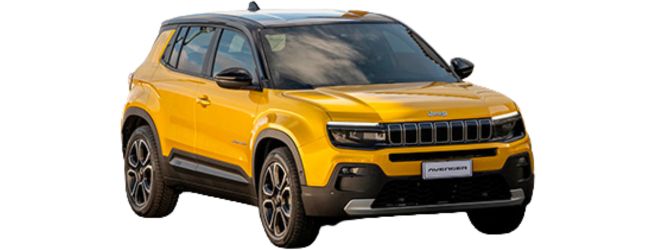
The Avenger is Jeep's smallest and first fully electric model, putting the brand's rugged identity onto the Stellantis compact-EV hardware. It uses a 54 kWh battery and a 115 kW (156 hp) front motor for a 400 km WLTP rating - the shortest headline figure in this platform family, partly because the chunky, upright Jeep styling and a slightly higher 13.5 kWh/100 km consumption ask a little more of the pack. The calculator starts from that 400 km figure and then adjusts for your speed, the temperature, the terrain and the urban-versus-motorway split of your driving. At just 4,084 mm long the Avenger is genuinely city-friendly, yet it keeps real Jeep traits like a high seating position and useful ground clearance, so it trades a few kilometres of theoretical range for character and everyday usability.
Driving the Jeep Avenger Electric in Winter
Winter shortens every EV's range, and the upright Avenger is no exception - though its Jeep DNA gives it some genuine cold-weather advantages. Near freezing, plan on roughly 285-315 km against the 400 km WLTP, falling toward 230-260 km in a hard -10 °C cold snap with the heater working. Where the Avenger earns its keep is traction: the raised ride height clears slush better than a low hatchback, and the Selec-Terrain Snow mode tailors the throttle and traction control for slippery surfaces, making it a reassuring small car when the roads turn white.
As honest planning guidance: expect roughly 80-85 percent of WLTP in mild weather, about 70-75 percent near freezing, and closer to 58-62 percent during a hard -10 °C spell with heavy heating. These are estimates derived from the 54 kWh battery and 13.5 kWh/100 km rating, not measured cold-chamber results - and because the Avenger's consumption is the highest in its platform family, its absolute winter range sits a little below its hatchback and crossback siblings.
Winter Tips:
- ❄️ Precondition the cabin from the Jeep/Uconnect app while plugged in, so warming up uses grid power rather than range
- ❄️ Lean on the heated seats and steering wheel first and keep cabin air temperature modest to save energy
- ❄️ Select Snow mode in Selec-Terrain for measured throttle and better grip on packed snow and ice
- ❄️ Use Eco mode in winter to soften throttle and trim climate draw without dulling everyday drivability
- ❄️ Keep the battery above roughly 20 percent in deep cold, where a fuller, warmer pack holds heat and rapid-charges faster
- ❄️ Fit proper winter tyres - on a car bought partly for its all-weather confidence they matter more than the small range cost
Winter Features:
- Heat pump available on higher trims, reducing the energy cost of cabin heating in sub-zero weather
- Selec-Terrain with a dedicated Snow mode that optimises traction on slippery surfaces
- Raised ground clearance that helps the Avenger clear moderate snow and slush
- Heated front seats on most trims, the lowest-energy way to keep occupants comfortable when it is freezing
- Battery conditioning that warms the pack toward its ideal window so cold-weather charging stays brisk
- Hill Descent Control on capable versions for controlled progress down icy, steep inclines
Jeep Avenger Electric Real-World Range vs WLTP
WLTP flatters every EV, so read 400 km as the optimistic ceiling. In mixed everyday driving the Avenger realistically returns around 320-355 km, with patient city running pushing higher as regeneration recovers energy in traffic. The upright body costs most at speed: at a 130 km/h motorway cruise the blunt frontal area works hard against the air, and an honest steady-state expectation is nearer 265-295 km - which still comfortably covers the urban and weekend duties the Avenger is built for.
From the numbers, 54 kWh used at the WLTP rate of 13.5 kWh/100 km gives the rated distance, but real roads run faster than the test cycle. A dependable planning figure is around 15-17 kWh/100 km in mixed use, climbing on the motorway, which is how the 320-355 km mixed estimate is reached. The Avenger's slightly higher appetite versus its Stellantis cousins is the direct cost of its taller, more rugged shape - the same shape that gives it its character and city-proof footprint.
Three things define the Avenger's real-world range: a 54 kWh battery on the efficient Stellantis platform, the aerodynamic drag of an upright, boxy SUV body, and regenerative braking that recovers most usefully in town. As ever, speed is the dominant lever - drag grows with the square of velocity, so easing your motorway cruise by 10-15 km/h does more for range than any single setting.
Getting the Most Range from Your Avenger
- Use Eco mode for both urban and motorway driving to cap power and trim climate output
- Engage B mode in city traffic to harvest the most energy from frequent stops
- Hold 110-120 km/h rather than higher speeds - on a boxy SUV the penalty for extra pace is steep
- Precondition the cabin while charging so you set off warm without dipping into the battery
- Keep tyres at the recommended pressure, which matters more with the Avenger's grippier all-weather rubber
- Plan longer trips in the Jeep/Uconnect app so charging stops fit neatly into your route
Jeep Avenger Electric Charging Strategy
- Hooked up to a 100 kW DC rapid charger, the Avenger goes from 10 to 80 percent in roughly half an hour, handy on a longer drive
- An 11 kW wallbox at home recharges the battery in around five and a half hours, easily within an overnight stay
- Using the standard 7.4 kW onboard charger, a full charge takes roughly seven and a half hours overnight
- For most owners, charging once a week at home covers a typical city and weekend routine
- A 20-minute rapid top-up adds roughly 115-125 km, enough to extend an out-of-town trip
- Charge to 80 percent for daily use and save 100 percent for the longer adventures that need the full buffer
Related Models
Peugeot e-2008
Closest sibling - same 54 kWh platform in a longer, more conventional compact SUV with a bigger boot
Fiat 500e 42kWh
Stellantis stablemate offering an even smaller, city-focused EV for tighter urban duty
Citroën ë-C4
Related crossback that swaps the Avenger's rugged stance for ride comfort and a little more range