
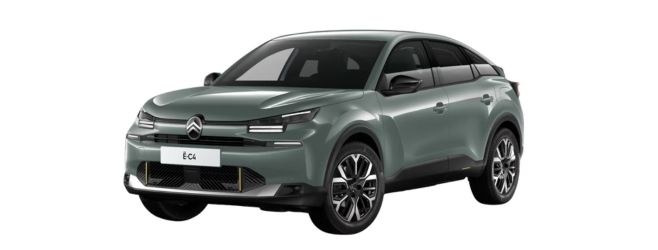
Citroën ë-C4
Real-world range calculator with WLTP data
Specifications
Calculate Real-World Range
Real-world range calculator with WLTP data
Estimated range
Results are estimates based on WLTP data and standard correction factors. Real-world range may vary based on many factors.
How the Citroën ë-C4 Range Calculator Works
The ë-C4 is Citroën's answer to the question of what an electric car feels like when comfort comes first. It pairs a 54 kWh battery with a single front-mounted 100 kW (136 hp) motor for a 420 km WLTP figure, and the calculator starts from that official number before adjusting for the things WLTP never measures: your cruising speed, the outside temperature, terrain, and how much of your driving happens in town versus on the motorway. With a rated 12.9 kWh/100 km, the ë-C4 is genuinely efficient for a raised crossback, and that efficiency is what lets a relatively modest battery stretch past 400 km on paper. Because the car is tuned for relaxed progress rather than acceleration (0-100 km/h takes 9.7 seconds and top speed is capped at 150 km/h), it naturally rewards the smooth inputs that also preserve range.
Driving the Citroën ë-C4 in Winter
Cold weather is the single biggest variable for any EV, and the ë-C4 is no exception. At freezing temperatures the chemistry inside the 54 kWh pack becomes more resistant and cabin heating draws real energy, so plan on noticeably less than the 420 km WLTP figure. A sensible expectation around 0 °C is roughly 300-330 km, falling toward 250-280 km in a genuine -10 °C cold snap with the heater working hard. The good news is that the ë-C4's soft, long-travel suspension is unfazed by frost-heaved winter roads, and the heat pump fitted to higher trims meaningfully reduces the heating penalty.
As a rough guide, expect around 80-85 percent of WLTP in mild spring and autumn conditions, roughly 70-75 percent near freezing, and closer to 60-65 percent during a hard -10 °C spell with heavy heater use. These are honest estimates derived from the car's 54 kWh battery and 12.9 kWh/100 km rating, not measured test figures - your own results shift with speed, route and how warm you keep the cabin.
Winter Tips:
- ❄️ Precondition the cabin from the MyCitroën app while the car is still plugged in, so the warm-up draws from the wall rather than the battery
- ❄️ Lean on the heated seats first and keep cabin air temperature modest - radiant warmth costs a fraction of what blower heating does
- ❄️ Choose Eco mode in winter to soften the throttle and trim climate output without making the car feel sluggish
- ❄️ Keep the state of charge above about 20 percent in deep cold, since a fuller pack holds heat and charges faster
- ❄️ Allow a little extra buffer when planning winter motorway legs, because high speed and cold air compound each other
- ❄️ Fit proper winter tyres - the extra grip matters more than the small range cost on a comfort-focused car like this
Winter Features:
- Heat pump available on upper trims, recovering ambient and drivetrain heat instead of relying purely on a resistive element
- Generous cabin insulation and thick Advanced Comfort seats that help retain warmth between heating cycles
- Heated front seats on most versions, the most efficient way to stay comfortable in the cold
- Battery thermal management that keeps the pack within its operating window for steady cold-weather charging
- Optional Grip Control with mud-and-snow modes for added confidence on slippery surfaces
Citroën ë-C4 Real-World Range vs WLTP
WLTP is a useful yardstick but a gentle one, so treat the 420 km label as a best case rather than a promise. In mixed everyday driving the ë-C4 realistically returns somewhere around 340-380 km, with patient town driving creeping higher thanks to frequent regeneration. Motorway range is where any tall car gives ground: cruising at 120 km/h, energy use climbs and a steady-state figure nearer 280-310 km is the honest expectation, calculated from the battery size and a highway consumption that sits well above the 12.9 kWh/100 km WLTP average.
Working from first principles, 54 kWh of usable energy at the WLTP rate of 12.9 kWh/100 km implies the rated distance, but real journeys rarely match the test cycle's gentle speeds. A practical planning rule is to assume about 15-16 kWh/100 km in everyday mixed use and to budget more on the motorway, which is how the 340-380 km mixed estimate is reached. The comfort-led regen tuning is smooth rather than aggressive, so most of the recovery benefit shows up in stop-start traffic.
Three things shape the ë-C4's real-world range: an efficient 54 kWh Stellantis pack, the aerodynamic penalty that comes with the higher, crossback body, and a soft regenerative calibration that prioritises a natural feel over maximum energy recapture. Speed remains the dominant factor - lift your steady cruise from 120 to 130 km/h and the range cost is disproportionate because drag rises with the square of speed.
Getting the Most Range from Your ë-C4
- Settle into Eco mode for everyday driving - it suits the car's relaxed nature and trims consumption with no real loss of usability
- Use the B drive mode in town to harvest more energy from the constant slowing that city traffic demands
- Hold a moderate motorway cruise; even dropping from 130 to 115 km/h noticeably extends how far each charge goes
- Precondition the cabin while charging so you set off warm without spending battery energy on the initial heat-up
- Check tyre pressures monthly, since under-inflation is a quiet but constant drain on range
- Plan longer trips in the MyCitroën app so charging stops line up with your route and reduce wasted detours
Citroën ë-C4 Charging Strategy
- On a 100 kW DC rapid charger, 10 to 80 percent takes roughly half an hour - long enough for a coffee, short enough not to derail a trip
- An 11 kW AC wallbox refills the pack overnight in about five and a half hours from low to full
- A standard 7.4 kW home connection takes around seven and a half hours, which still comfortably covers an overnight charge
- For most owners, one home charge a week is enough to cover typical commuting distances
- A 20-minute rapid top-up adds roughly 120-130 km, ideal for breaking up a longer journey
- Charge to 80 percent for daily use and save 100 percent for the days you genuinely need the full 420 km buffer
Related Models
Peugeot e-2008
Stellantis sibling with the same 54 kWh pack in a more conventional compact SUV body
Opel Astra-e
Shares the platform and battery but in a sharper-handling hatchback aimed at keener drivers
MG MG4 Electric 64kWh
Value rival offering a larger 64 kWh battery and more range for buyers who prioritise distance over comfort