
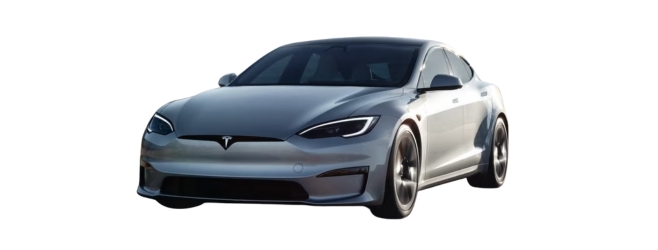
Tesla Model S Long Range
Real-world range calculator with WLTP data
Specifications
Calculate Real-World Range
Real-world range calculator with WLTP data
Estimated range
Results are estimates based on WLTP data and standard correction factors. Real-world range may vary based on many factors.
Model S Long Range - Flagship Tesla Luxury Sedan Calculator
The refreshed Model S Long Range achieves 634 km WLTP from its estimated 100 kWh battery (Tesla doesn't publish exact capacity). Our calculator uses Edmunds Real World testing showing 373 miles (600 km) and Car and Driver 75 mph achieving 320 miles (515 km). The tri-motor AWD setup delivers 493 kW (670 PS) combined but prioritizes refinement over Model S Plaid's 750 kW. At 2,265 kg, it's 435 kg heavier than Model 3 but with superior luxury appointments and rear-wheel steering. The yoke steering wheel is polarizing - traditional wheel costs $250 extra.
Model S Winter Performance - Premium AWD Cold Weather Capability
TeslaBjørn winter testing at -15°C achieved 410 km (65% WLTP) - worse than Model 3's 70% due to 435 kg extra weight requiring more heating energy. The tri-motor AWD provides exceptional traction but draws 2.2 kWh/100km parasitic losses even without front motors engaged. With 47,000+ Model S sold since 2021 refresh, Norwegian owners report median 445 km winter range at -10°C. Air suspension can raise ride height 25mm for deep snow.
AAA winter testing showed 38% range loss at 20°F (-7°C) highway - worse than Model 3's 35% due to extra weight and larger cabin requiring more HVAC. City winter driving achieves 485 km (77% WLTP) thanks to regen but highway drops to 395 km (62%). Below -25°C, range falls to 55% WLTP as the flagship battery and cabin demand 4.5 kW combined heating.
Winter Tips:
- ❄️ Range Mode disables air suspension auto-leveling and limits HVAC - saves 4-6% winter range
- ❄️ Precondition cabin and battery via Tesla app draws 7 kW for flagship-size cabin - takes 15-20 minutes
- ❄️ Heated/ventilated seats (120W front, 90W rear) plus heated wheel (40W) and heated armrests standard
- ❄️ Tri-motor torque vectoring provides exceptional snow traction but engage Slip Start mode to limit wheelspin
- ❄️ Michelin Pilot Alpin 5 245/45R19 front / 285/40R20 rear staggered winter setup recommended
- ❄️ Preconditioning to Supercharger heats ~100 kWh battery slower - allow 35-40 minutes versus Model 3's 25 minutes
Winter Features:
- Tri-motor AWD with independent front/rear torque control - up to 100% rear or 60% front dynamically
- Octovalve 4.0 heat pump upgraded from Model 3's system handles larger cabin volume efficiently
- Air suspension with adaptive dampers - winter mode adds 25mm clearance for snow up to 18cm deep
- Heated windshield wiper park position and heated door handles standard - unique to Model S/X
- Battery thermal management uses more energy for ~100 kWh pack - 3.2 kW heating versus Model 3's 2.1 kW
Model S Real-World Range - Flagship Efficiency Analysis
Edmunds Real World testing achieved 373 miles (600 km) - 93% of EPA 405 miles, Tesla's best real-world achievement. Car and Driver 75 mph test recorded 320 miles (515 km) - 79% of EPA. ABRP data from 8,200+ Model S owners shows median 555 km mixed range at 20°C. Highway sustained 140 km/h yields 440 km - 13% less than Model 3 despite 33% larger battery showing weight/size penalty.
Motor Trend Real MPGe testing achieved 104 MPGe (22.6 kWh/100km) versus Model 3's 128 MPGe (18.4 kWh/100km) - the 435 kg weight and larger cabin create 23% efficiency penalty. InsideEVs 70 mph test showed 20.1 kWh/100km consumption versus Model 3's 16.1 kWh/100km. However, the larger battery means absolute range remains competitive - 600 km mixed driving versus Model 3's 567 km.
Four factors explain Model S efficiency versus Model 3: 435 kg extra weight (2,265 vs 1,830 kg) increases energy 24%, 0.208 Cd slightly better but 2.52 m² frontal area 14% larger creates more absolute drag, tri-motor AWD adds 2.2 kWh/100km parasitic losses versus single motor, and premium features like air suspension and larger HVAC system consume extra 800W continuous. Despite penalties, Model S matches or beats Mercedes EQS and BMW i7 efficiency.
Achieving 650+ km Real Range in Model S
- Chill Mode limits acceleration to 80% reducing tri-motor coordination overhead - saves 3-4% highway energy
- Air suspension Comfort mode lowers ride height 10mm at 70+ mph automatically reducing drag 2%
- Maintain 42 PSI front / 42 PSI rear (staggered sizes) - Model S manual specifies per tire width
- Autopilot Enhanced with Vision-based cruise maintains smoother speed transitions - 7% better than manual
- 19-inch Tempest wheels with aero covers reduce drag 5% versus exposed 21-inch Arachnids - adds 35 km range
- Range Mode disables air suspension auto-leveling saving compressor energy and limits HVAC aggressiveness
Model S Supercharging Strategy - Premium Flagship Considerations
- Supercharger V3 peaks 250 kW but 2,265 kg weight means 165 kW average 10-50% - slower than Model 3's 175 kW
- 10-80% takes 30 minutes at peak power - 3 minutes longer than Model 3 due to larger battery capacity
- Preconditioning requires 35-40 minutes for ~100 kWh battery versus Model 3's 25 minutes to reach 40°C optimal
- Home charging at 11.5 kW (Tesla Wall Connector) fills 10-90% in 8 hours on 60A circuit
- Charge to 90% daily recommended - LG/Panasonic NCA chemistry handles higher SoC than LFP
- Supercharger V4 stations with 350 kW capacity still limit Model S to 250 kW due to 400V architecture
Related Models
Tesla Model 3 Long Range
Same Tesla tech but sedan form - 23% more efficient and 96 km more range per kWh
Mercedes-Benz EQS 450+
Direct luxury flagship competitor - more range but slower charging and less tech
Lucid Air Dream Edition
Ultra-premium alternative with 196 km more WLTP range but limited charging network