
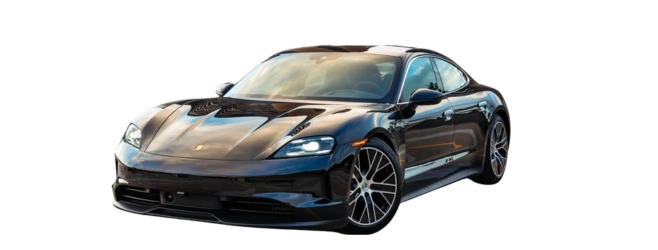
Porsche Taycan 4S
Real-world range calculator with WLTP data
Specifications
Calculate Real-World Range
Real-world range calculator with WLTP data
Estimated range
Results are estimates based on WLTP data and standard correction factors. Real-world range may vary based on many factors.
How the Porsche Taycan 4S Range Calculator Works
The Porsche Taycan 4S is rated at 507 km WLTP, built on a 93.4 kWh battery and a rated efficiency of 18.4 kWh/100 km. Our calculator takes those real numbers as the starting point and then adjusts for speed, temperature, terrain and climate use - the variables WLTP leaves out. The Taycan is Porsche's electric sports sedan, and it is engineered for driving dynamics first, efficiency second - which is exactly why its consumption is higher than a comfort-focused EV of similar size. Its defining technical feature is a genuine 800V architecture, rare in this class, which allows very high DC charging speeds and helps the powertrain deliver power with less heat and loss at speed. The dual-motor all-wheel-drive setup produces 390 kW (about 530 PS) for a 0-100 km/h time of 4.0 seconds, and a two-speed transmission on the rear axle balances launch punch with efficiency at higher speeds. At a steady 130 km/h the Taycan draws roughly 22-25 kWh/100 km, good for around 370-420 km, while easing to 110 km/h pushes that toward 450 km because aerodynamic drag falls sharply with speed.
Porsche Taycan 4S Winter Range and Cold-Weather Driving
The Taycan loses range in the cold for the usual two reasons: the battery delivers less energy below about 10°C, and heating the cabin draws real power. From its 507 km WLTP baseline, expect roughly 330-380 km around -5°C to -7°C, dropping toward 290-330 km in harder cold near -15°C. The performance focus and, on many cars, summer-biased tyres mean cold-weather efficiency is not the Taycan's strong suit - but the standard heat pump helps, and the real winter advantage is charging: thanks to 800V, a cold-weather range loss is easily topped up in a short, fast stop. Fitting proper winter tyres transforms grip, and the all-wheel-drive system then provides genuinely confident traction on cold, wet and snowy roads.
Plan for roughly 330-380 km around -5°C to -7°C and 290-330 km near -15°C, against the 507 km WLTP rating. City driving holds up better than the motorway because lower speeds cut aerodynamic losses and offer more regeneration. The Taycan's sporty priorities cost some cold-weather efficiency, but its 800V fast charging means a winter top-up is quick, making frequent short stops a practical way to cover real distance.
Winter Tips:
- ❄️ Precondition the cabin and battery from the Porsche Connect app while plugged in, so the energy comes from the grid rather than your range
- ❄️ Lean on the heated sports seats and heated wheel first - direct warmth costs a fraction of what heating cabin air does
- ❄️ Keep motorway speed moderate in winter; the cold penalty stacks on the speed penalty, so 110 km/h saves a lot over 130
- ❄️ Fit proper winter tyres if the car is on summer performance rubber - grip matters far more than the small range cost
- ❄️ Lean on the 800V fast charging: a quick stop replaces the cold-weather range loss faster than almost any rival
- ❄️ Use a smooth driving style on cold roads; the strong power output is easy to over-apply on low-grip surfaces
Winter Features:
- A standard heat pump reduces the energy needed to heat the cabin versus a resistive-only heater
- 800V architecture enables very fast DC charging, so winter range loss is quick and easy to top up
- Dual-motor all-wheel drive provides strong, confident traction on cold, wet and snowy roads with the right tyres
- Liquid battery thermal management keeps the pack in a usable temperature window and supports fast winter charging
- App-based preconditioning warms the car on a timer so you leave with a comfortable cabin on cold mornings
Porsche Taycan 4S Real-World Range vs WLTP
The 507 km WLTP figure comes from a lab cycle; on the road, expect roughly 75-85% in mild weather, which works out to around 380-430 km of mixed driving. The Taycan's performance focus means it tends to sit toward the lower end of the typical WLTP-to-real ratio, particularly on the motorway and when the power is enjoyed. A confident everyday expectation in spring and autumn is around 390-420 km - shorter than a range-focused sedan, but offset by the fastest charging in its class.
Working from the Taycan's rated 18.4 kWh/100 km and 93.4 kWh usable battery: at a relaxed 100-110 km/h it sits near rated consumption and can approach 450 km; at 130 km/h consumption rises to roughly 22-25 kWh/100 km, which translates to about 370-420 km. These are engineering estimates derived from the published efficiency and battery size rather than a single test, so treat them as planning guidance. Driven enthusiastically the figure drops further - performance EVs are energy-hungry when used hard - but the 800V charging means stops are short and the next leg comes quickly.
The Taycan trades some efficiency for dynamics: the dual-motor all-wheel-drive system and performance hardware add parasitic losses versus a single-motor cruiser, summer-biased performance tyres prioritise grip over rolling resistance, and the mass of a fully-equipped sports sedan all raise consumption. Working in its favour, the two-speed transmission helps high-speed efficiency and the 800V architecture reduces losses, while the genuine advantage is charging speed rather than outright range. As always, speed dominates - drag rises with the square of velocity, so the 110-versus-130 km/h difference is large.
Getting the Most Range From Your Porsche Taycan 4S
- Cruise at 110-120 km/h on the motorway rather than 130 - it is the single biggest factor in real range
- Drive smoothly and resist the strong power in everyday use - hard acceleration is the fastest way to drain the battery
- Use the Range driving mode and recuperation so deceleration energy is recovered into the battery instead of lost as heat
- Precondition the cabin while charging at home so you set off warm without spending battery on heat-up
- Choose the smaller aero wheel option over larger performance wheels where you can - they reduce drag and rolling resistance
- Keep tyres at the recommended pressure; under-inflation quietly eats range on every journey
Porsche Taycan 4S 800V Charging Strategy
- On a high-power DC charger the 800V Taycan can pull up to 270 kW, recovering a large chunk of range in a short stop
- The 800V architecture is the Taycan's standout - fast-charging speed offsets its shorter range on road trips
- Home AC charging fills the pack overnight on a wallbox - ideal for daily commuting and routine use
- Charge to 80% for daily use and reserve 100% charges for days you genuinely need the full 507 km headroom
- Use route planning so the car preconditions the battery before a DC stop, giving faster, more consistent charging
- In winter, let the battery warm before fast charging - cold cells charge slower, so plan stops accordingly
Related Models
Audi e-tron GT
The Taycan's 800V platform sibling - the e-tron GT shares the architecture and fast charging but leans a little more toward refined grand touring than outright sport
Tesla Model S Long Range
A performance luxury sedan rival - longer range and Supercharger access, where the Taycan counters with sharper handling and 800V charging
BMW i4 eDrive40
A more affordable German electric sport sedan - less power and a 400V system, but a lighter, simpler alternative to the Taycan's high-performance brief