
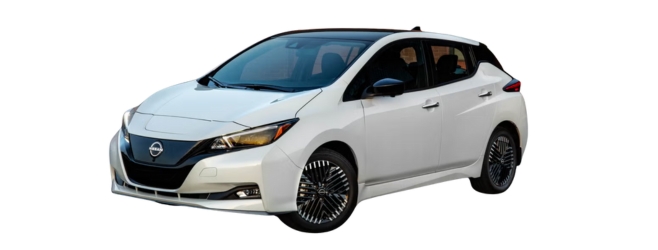
Nissan Leaf e+
Real-world range calculator with WLTP data
Specifications
Calculate Real-World Range
Real-world range calculator with WLTP data
Estimated range
Results are estimates based on WLTP data and standard correction factors. Real-world range may vary based on many factors.
Nissan Leaf e+ Range Calculator - How It Works
Our calculator starts from the Nissan Leaf e+ official WLTP range of 385 km and adjusts for real-world driving conditions using the car's rated 15.3 kWh/100km efficiency and 59 kWh usable battery. The Leaf e+ is a veteran value hatchback - one of the longest-serving mass-market EVs - powered by a 160 kW (218 hp) front motor good for 0-100 km/h in 6.9 seconds and a 157 km/h top speed. The defining engineering trait is its passively air-cooled battery pack, which keeps cost and weight down but, unlike liquid-cooled rivals, cannot actively manage cell temperature. That single design choice shapes everything about how the Leaf e+ charges and behaves on long trips, so we factor it into our estimates rather than assuming ideal lab conditions.
Nissan Leaf e+ Winter Driving and Cold-Weather Range
The Leaf e+ remains a practical winter commuter, but its air-cooled battery and modest charging speed mean cold weather hits it harder than liquid-cooled rivals. Because the pack relies on ambient airflow rather than active heating or cooling, both range and charge speed are more exposed to temperature swings. A few habits keep it dependable through the cold months:
Expect noticeably reduced range in cold conditions. Around -10°C, real-world range can fall well below the 385 km WLTP figure, with the biggest losses on the motorway where heating and aerodynamic drag combine. Because the battery is air-cooled, it also warms up slowly, so the first fast charge of a cold day is typically slower than the ~50 kW peak until the pack reaches a better temperature.
Winter Tips:
- ❄️ Precondition the cabin while still plugged in so the heater pull comes from the wall, not the 59 kWh battery
- ❄️ Use seat and steering wheel heating instead of full cabin heating to save several kilometres of range
- ❄️ Drive in e-Pedal mode to maximise regenerative braking, though regen is reduced when the pack is very cold
- ❄️ Plan around the ~50 kW CHAdeMO limit - cold charging is slower still, so allow extra time at stops
- ❄️ Keep tyre pressures topped up, as cold air lowers them and increases rolling resistance
- ❄️ Park indoors or in a garage when possible, since a warmer air-cooled pack starts the day with more usable range
Winter Features:
- Standard heat-management is passive - the air-cooled pack has no liquid heating, so warm-up depends on driving and ambient temperature
- Cabin preconditioning via the NissanConnect app warms the interior before departure while on the charger
- Heated seats and heated steering wheel let you stay comfortable on far less energy than cabin heat
- e-Pedal regenerative braking recovers energy on descents, with output limited when the battery is cold
- Eco mode softens throttle response and trims climate draw to stretch winter range
Nissan Leaf e+ Real-World Range vs WLTP
The Leaf e+ is rated at 385 km WLTP. As a transparent estimate based on its 59 kWh usable battery and 15.3 kWh/100km efficiency, most drivers should expect roughly 80-90% of the WLTP figure in mild conditions and gentle mixed driving - call it around 310-345 km. Cold weather and sustained motorway speeds push real-world range lower, as with any EV, and the Leaf's air-cooled pack offers little buffer against temperature extremes.
These are transparent estimates derived from the car's own rated efficiency and battery size, not third-party test results. In steady town and suburban driving at moderate temperatures the Leaf e+ comfortably covers daily commutes, while a fully laden motorway run at 120-130 km/h will see range closer to the lower end and consumption rise above the 15.3 kWh/100km rating.
Three things shape the gap between WLTP and reality on the Leaf e+: the air-cooled battery, which leaves the pack more exposed to heat and cold than liquid-cooled competitors; the relatively modest aerodynamic efficiency of the hatchback body at speed; and the slow ~50 kW CHAdeMO charging, which makes long trips depend on careful planning rather than rapid top-ups.
Maximising Your Nissan Leaf e+ Range
- Drive in Eco mode and use e-Pedal one-pedal driving to recover the most energy in stop-start traffic
- Keep motorway speeds moderate - dropping from 130 to 110 km/h meaningfully cuts consumption on the Leaf's bluff body
- Precondition the cabin on shore power before setting off so the battery starts the trip full and warm
- Maintain correct tyre pressures and check them often, as under-inflation noticeably raises rolling resistance
- Use seat and wheel heating rather than cabin heat to protect range in cold weather
- Avoid carrying unnecessary weight or roof loads that add drag and reduce the 385 km potential
Nissan Leaf e+ Charging Strategy
- DC fast charging is slow at around 50 kW via CHAdeMO - plan longer stops than a CCS rival would need
- Avoid back-to-back rapid charges on long trips - the air-cooled pack throttles charge speed as it heats up (the well-known 'rapidgate' effect)
- Note that CHAdeMO infrastructure is being phased out in favour of CCS, so check connector availability before relying on a route
- Do most charging overnight at home on AC, where 6.6 kW comfortably refills the 59 kWh pack by morning
- Let the battery warm up before fast charging in winter to get closer to the full ~50 kW rather than a cold, slower rate
- For daily use, charging to around 80% preserves long-term battery health on the air-cooled pack
Related Models
Chevrolet Bolt EUV
Similarly priced value hatchback-crossover with comparable range but CCS fast charging instead of CHAdeMO
Hyundai Kona Electric
Practical compact EV with a liquid-cooled battery and faster, more consistent DC charging
Volkswagen ID.3 Pro
Roomier hatchback alternative with quicker CCS charging and stronger motorway efficiency