
Mazda MX-30
Real-world range calculator with WLTP data
Specifications
Calculate Real-World Range
Real-world range calculator with WLTP data
Estimated range
Results are estimates based on WLTP data and standard correction factors. Real-world range may vary based on many factors.
How the Mazda MX-30 Range Calculator Works
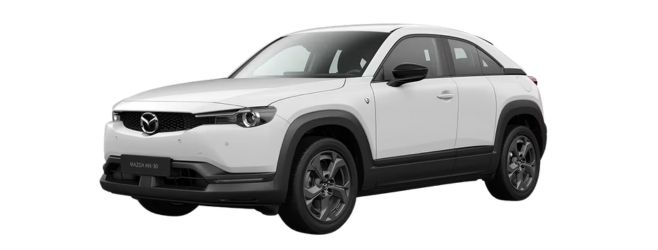
The Mazda MX-30 is rated at 200 km WLTP from a usable 35.5 kWh battery and a rated efficiency of 17.8 kWh/100 km. Our calculator starts from those real numbers and then adjusts for the variables WLTP leaves out: speed, temperature, terrain and climate use. The MX-30 is unusual because Mazda chose a deliberately small battery. Rather than chase a big headline range, Mazda argues that a smaller pack uses fewer raw materials to build and, charged from a reasonable electricity mix, can carry a lower lifetime carbon footprint than a large-battery EV that is rarely driven far. The result is a car best understood for what it actually is: a stylish, well-built urban second car, not a long-distance tourer. The 107 kW (145 hp) front motor produces 271 Nm and delivers power in the smooth, linear, slightly sporty way that is typically Mazda, while the freestyle rear-hinged doors and cork-trimmed cabin give it a genuinely distinctive character. Be honest with the trade-off before buying: at a steady 120 km/h the MX-30 draws far more than its rated figure and real range falls toward 130-145 km, whereas relaxed city driving with regenerative braking can approach or even slightly beat the 200 km rating. If your days are short and you can charge at home, the small battery is rarely a problem; if you regularly drive 200 km in one go, this is the wrong car.
Mazda MX-30 Winter Range and Cold-Weather Driving
Winter is where the MX-30's small battery demands the most honesty. The pack loses range in the cold for the usual two reasons - the cells deliver less energy below about 10°C, and heating the cabin draws real power - but with only 35.5 kWh to start with, those losses leave a thinner margin than they would on a big-battery EV. From the 200 km WLTP baseline, plan for roughly 130-145 km around -5°C to -7°C and toward 110-130 km in harder cold near -15°C. The MX-30 also has no heat pump, so cabin warmth comes from a resistive heater that draws more power than the heat pumps fitted to many rivals - the single biggest reason winter range falls. The upside is real: the compact cabin warms quickly, and because the battery is small, even a slow charger refills it overnight, so frequent top-ups are easy. For an urban commuter doing 30-50 km a day with home charging, the MX-30 stays workable through winter; as a sole car in a cold region with long trips, the margin is genuinely tight.
Plan for roughly 130-145 km around -5°C to -7°C and 110-130 km near -15°C, against the 200 km WLTP rating. City driving holds up better than the motorway because lower speeds cut aerodynamic losses and offer more regen. The absence of a heat pump means the cold-weather hit is larger than on many rivals, so the honest conclusion stands: the MX-30 suits mild climates or a second-car role in cold regions, and works for short daily commutes with home charging rather than long winter journeys.
Winter Tips:
- ❄️ Precondition the cabin and battery while plugged in - on such a small pack, taking heat from the grid instead of the battery makes a noticeable difference to usable winter range
- ❄️ Lean on the heated seats and heated wheel first - direct warmth costs a fraction of what heating the whole cabin does, which matters most when there is no heat pump
- ❄️ Keep winter speeds moderate; the cold penalty stacks on the speed penalty, so staying under 100 km/h protects an already limited range
- ❄️ Use regenerative braking actively in town - city driving recovers energy and is where the MX-30 holds up best in winter
- ❄️ Park in a garage when you can so the battery and cabin start warmer, cutting the energy spent on heat-up
- ❄️ Plan slightly more frequent charging in winter - the small battery refills quickly, so a short stop restores a meaningful share of range
Winter Features:
- No heat pump is fitted, so a resistive PTC heater handles cabin warmth - reliable in any cold but more power-hungry than rivals' heat pumps
- The compact cabin volume heats up fast, which softens the impact of the resistive heater on short journeys
- Heated front seats and a heated steering wheel are available and let you cut cabin air heating while staying comfortable
- Battery thermal management keeps the pack in a usable temperature window, supporting consistent everyday behaviour
- Departure timer warms the car on a schedule so you leave with a comfortable cabin and a battery that is not stone cold
Mazda MX-30 Real-World Range vs WLTP
The 200 km WLTP figure comes from a lab cycle; on the road, mild-weather driving typically returns around 80-90% of it, which works out to roughly 165-180 km of mixed use. Gentle town driving can edge close to the full 200 km thanks to regen and low speeds, while sustained motorway cruising is where the number falls hardest. A realistic everyday expectation in spring and autumn is around 165-185 km - perfectly adequate for commuting and errands, but firmly in city-car territory rather than long-distance.
Working from the MX-30's rated 17.8 kWh/100 km and 35.5 kWh usable battery: at relaxed town speeds it sits near or slightly below rated consumption and can approach 180-190 km, while at a steady 120 km/h consumption rises sharply and range drops toward 130-145 km. These are engineering estimates derived from the published efficiency and battery size rather than a single road test, so treat them as planning guidance. The high rated consumption reflects a 1,720 kg kerb weight that is heavy for such a small pack - efficiency in kWh/100 km is not the MX-30's strength, but absolute energy use per trip stays low simply because the journeys it is built for are short.
The MX-30's range is shaped by a few clear factors. The deliberately small 35.5 kWh battery caps the headline number, front-wheel drive keeps drivetrain losses modest, and a 1,720 kg kerb weight pushes rated consumption up. Working in its favour around town are strong regen and low speeds; working against it on the motorway is the same speed-versus-drag relationship that affects every EV, where drag rises with the square of velocity. The key is to match the car to its purpose: as an urban EV the small pack is right-sized, not compromised, and it charges quickly because there is less to fill.
Getting the Most Range From Your Mazda MX-30
- Keep motorway speed under 100 km/h - on a small battery the speed penalty bites harder, so easing off is the single biggest lever for real range
- Use Mazda's i-DM driving feedback to smooth your inputs and trim the energy lost to hard acceleration and braking
- Make the most of regenerative braking in town, where the MX-30 is genuinely efficient and recovers energy on every slowdown
- Precondition the cabin while charging at home so you set off warm without spending battery on heat-up
- Keep tyres at the recommended pressure - under-inflation quietly eats range, and it matters more on a car with this little to spare
- Plan routes to favour the city driving where the MX-30 excels rather than long, fast motorway stretches
Mazda MX-30 Charging Strategy
- On a 50 kW DC charger a 10-80% top-up takes around 36 minutes - modest power, but the small pack means short stops still add useful range
- Home AC charging around 6.6 kW fills the battery overnight in roughly five to six hours - more than enough for daily use
- Because the battery is small, even a slow 3 kW home socket can fully recharge it overnight, so a dedicated wallbox is helpful but not essential
- For most urban commuters, charging every two to three days at home comfortably covers daily driving
- A quick 15-minute DC stop adds roughly 50 km - handy for errands or to extend an occasional longer trip
- The small pack tolerates regular full charges well, so topping up to 100% for daily use is reasonable on the MX-30
Related Models
Mini Cooper SE
The closest rival in spirit - another small-battery, city-focused EV with a premium feel and a similarly honest urban range rather than long-distance ambitions
Fiat 500e 42kWh
A stylish city EV with a larger 42 kWh battery and 320 km WLTP, showing how a slightly bigger pack buys more everyday flexibility than the MX-30's 200 km
Volvo EX30 Single Motor
A modern compact crossover with a much larger 51 kWh battery and 344 km WLTP - useful if you like the MX-30's premium character but need real range