
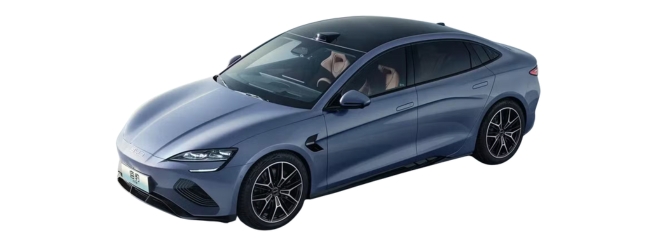
BYD Seal Premium
Real-world range calculator with WLTP data
Specifications
Calculate Real-World Range
Real-world range calculator with WLTP data
Estimated range
Results are estimates based on WLTP data and standard correction factors. Real-world range may vary based on many factors.
How the BYD Seal Premium Range Calculator Works
The BYD Seal Premium is rated at 570 km WLTP, drawn from an 82.5 kWh Blade battery using LFP (lithium-iron-phosphate) chemistry and a rated efficiency of 14.5 kWh/100 km. Our calculator takes those real numbers as the starting point and then adjusts for speed, temperature, terrain and climate use - the variables WLTP leaves out. The Seal is BYD's sleek rear-drive electric sedan: a single 230 kW (313 PS) rear motor delivers 0-100 km/h in 5.9 seconds, brisk without being a hot rod. Its signature is the Blade battery, a cell-to-pack LFP design that BYD builds in-house and that prizes durability and safety - LFP cells are happy being charged to 100% routinely. With a clean low-slung body and a large 82.5 kWh pack, the Seal is a capable long-distance car: at a steady 130 km/h it draws roughly 19-21 kWh/100 km, good for around 390-430 km, while easing to 110 km/h pushes that back toward 460 km because aerodynamic drag falls sharply with speed.
BYD Seal Winter Range and Cold-Weather Driving
The Seal loses range in the cold for the usual two reasons: the battery delivers less energy below about 10°C, and heating the cabin draws real power. From its 570 km WLTP baseline, expect roughly 370-410 km around -5°C to -7°C, dropping toward 320-360 km in harder cold near -15°C. There is one extra winter consideration with LFP chemistry: cold cells accept charge more slowly, so DC fast charging takes longer when the pack is cold and preconditioning matters more than on a nickel-based car. Rear-wheel drive also rewards good tyres - fitting proper winter or all-season rubber transforms traction on cold, wet and slippery roads.
Plan for roughly 370-410 km around -5°C to -7°C and 320-360 km near -15°C, against the 570 km WLTP rating. City driving holds up better than the motorway because lower speeds cut aerodynamic losses and offer more regen. The main practical winter point with the Seal is charging: let the LFP battery warm and precondition before a fast-charge stop, otherwise cold cells slow the session noticeably.
Winter Tips:
- ❄️ Precondition the cabin and battery from the BYD app while plugged in, so the energy comes from the grid rather than your range
- ❄️ Lean on the heated seats and heated steering wheel first - direct warmth costs a fraction of what heating cabin air does
- ❄️ Keep motorway speed moderate in winter; the cold penalty stacks on the speed penalty, so 110 km/h saves a lot over 130
- ❄️ Allow extra charging time when the pack is cold - LFP cells in particular charge slower until they warm up
- ❄️ Fit winter or all-season tyres if the car came on summer rubber - rear-wheel drive especially rewards good grip
- ❄️ Use Eco mode in winter to soften throttle response and trim the climate system's draw
Winter Features:
- A heat pump reduces the energy needed to heat the cabin versus a resistive-only heater
- Liquid battery thermal management keeps the Blade LFP pack within a usable temperature window
- Heated front seats and a heated steering wheel let you cut cabin air heating while staying comfortable
- LFP chemistry is known for stable behaviour and durability, including resistance to thermal issues
- App-based preconditioning warms the car on a timer so you leave with a comfortable cabin on cold mornings
BYD Seal Real-World Range vs WLTP
The 570 km WLTP figure comes from a lab cycle; on the road, expect roughly 80-90% in mild weather, which works out to around 455-510 km of mixed driving. Gentle town use can edge higher thanks to regen, while sustained motorway cruising is where the number falls. A confident everyday expectation in spring and autumn is around 460-490 km - long legs for a mid-size sedan, helped by the car's slippery shape.
Working from the Seal's rated 14.5 kWh/100 km and 82.5 kWh usable battery: at a relaxed 100-110 km/h it sits near rated consumption and can approach 500 km; at 130 km/h consumption rises to roughly 19-21 kWh/100 km, which translates to about 390-430 km. These are engineering estimates derived from the published efficiency and battery size rather than a single test, so treat them as planning guidance. LFP packs are denser and heavier per kWh than nickel-based cells, so the Seal carries some extra weight, but its clean aerodynamics keep motorway consumption in check.
The Seal's range comes from a few things: a large 82.5 kWh pack, a slippery low-slung body, and a single rear motor that avoids the extra losses of an all-wheel-drive system. Against it works the inherent weight of LFP chemistry, which is less energy-dense than nickel-based cells and so adds mass for a given capacity. As always, speed dominates: drag rises with the square of velocity, so the difference between 110 and 130 km/h is large.
Getting the Most Range From Your BYD Seal
- Cruise at 110-120 km/h on the motorway rather than 130 - it is the single biggest factor in real range
- Use the stronger regen setting so braking energy is recovered into the battery instead of lost as heat
- Choose Eco mode for long trips to soften throttle and trim climate draw
- Precondition the cabin while charging at home so you set off warm without spending battery on heat-up
- Keep the standard wheels where you can - larger optional wheels add drag and rolling resistance
- Keep tyres at the recommended pressure; under-inflation quietly eats range on every journey
BYD Seal LFP Charging Strategy
- On a capable DC charger the Seal peaks at 150 kW, giving a 10-80% top-up in roughly 30-35 minutes
- 11 kW AC charging fills roughly 10-100% overnight in about 8-9 hours - ideal for a home wallbox
- Charge to 100% routinely - LFP chemistry tolerates a full charge daily without the same wear as nickel cells
- An occasional full charge also helps the car keep its state-of-charge readout accurate on LFP packs
- In winter, precondition and let the battery warm before fast charging - cold LFP cells charge noticeably slower
- A 20-30 minute DC stop adds plenty of range for the next leg without waiting for a full charge
Related Models
Tesla Model 3 Long Range
The Seal's most direct rival - the Model 3 brings a wider fast-charging network and slightly lower consumption, while the BYD counters on value and battery durability
Hyundai IONIQ 6 Long Range
A streamlined Korean sedan with an 800V system and much faster charging, where the Seal typically undercuts on price
MG MG4 Electric 64kWh
A more affordable electric hatchback from the same broader Chinese-owned stable, smaller and less premium than the Seal but a budget-minded alternative