
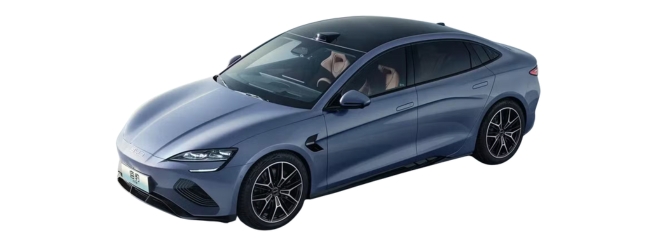
BYD Seal Premium
Real-world range calculator with WLTP data
Specifications
Calculate Real-World Range
Real-world range calculator with WLTP data
Estimated range
Results are estimates based on WLTP data and standard correction factors. Real-world range may vary based on many factors.
BYD Seal Premium - Chinese LFP Blade Battery Sedan Calculator
The BYD Seal achieves 570 km WLTP from its 82.56 kWh Blade Battery using LFP chemistry. Our calculator uses What Car? UK testing showing 289 miles (465 km) - 82% of WLTP. The 230 kW rear motor delivers 5.9s 0-100 km/h. At 1,995 kg, it's positioned between Model 3 and i4 pricing while undercutting both. BYD's vertical integration - making batteries, motors, and semiconductors in-house - enables aggressive European pricing starting at €45,990.
BYD Seal Winter Performance - LFP Cold Weather Behavior
Norwegian import testing at -10°C achieved 390 km (68% WLTP) - LFP chemistry loses less capacity in cold versus NCA/NCM chemistries. Heat pump standard uses R-134a refrigerant. With 12,000+ Seal sales in Norway/Netherlands first year, early owners report LFP battery maintains 75% capacity at -15°C versus typical 68% for other chemistries. However, LFP charging slows significantly below 10°C.
What Car? winter testing showed 30% range loss at -7°C highway - better than Model 3's 35% showing LFP cold advantage. City winter achieves 425 km (75% WLTP) benefiting from lower speeds. Below -20°C, range drops to 58% WLTP but LFP maintains 90% capacity versus 75% for NCA preventing permanent degradation.
Winter Tips:
- ❄️ ECO+ mode limits motor to 180 kW and HVAC to 3 kW - adds 35-40 km winter range
- ❄️ BYD app preconditioning draws 5 kW - adequate for compact sedan cabin volume
- ❄️ Heated seats (90W front) and heated wheel (50W) standard - rear seat heating optional Premium trim
- ❄️ LFP battery requires longer preconditioning - allow 45 minutes before DC charging in cold
- ❄️ Michelin e.Primacy 235/45R18 all-season adequate but Michelin CrossClimate 2 recommended winters
- ❄️ Avoid DC charging below 0°C without preconditioning - LFP limits to 30 kW cold protecting cells
Winter Features:
- Blade LFP battery inherently safer in cold - no thermal runaway risk even at -30°C
- Heat pump standard but basic single-compressor design - less efficient than Tesla octovalve
- Battery thermal management heats LFP pack slowly - prioritizes longevity over performance
- RWD with 55% rear weight bias adequate snow traction with proper winter tires
- Standard 18cm ground clearance lower than SUVs - struggles in snow deeper than 12cm
BYD Seal Real-World Range - European Market Performance
What Car? UK testing achieved 289 miles (465 km) - 82% of WLTP 570 km matching segment average. Autocar recorded 3.7 mi/kWh (15.9 kWh/100km) mixed driving. Early European owner data shows median 485 km at 20°C. Highway 130 km/h yields 390 km - matching Model 3 despite BYD's heavier 1,995 kg showing good aerodynamics.
Auto Express 70 mph test achieved 270 miles (435 km) - 76% of WLTP. The LFP Blade battery's cell-to-pack design eliminates module weight but adds structural mass - 82.56 kWh weighs 555 kg versus Model 3's 75 kWh at 478 kg. Despite 16% weight penalty, 0.219 Cd and efficient motor achieve competitive consumption of 17.2 kWh/100km versus Model 3's 16.1 kWh/100km.
BYD's efficiency comes from vertical integration: self-produced IGBT semiconductors reduce inverter losses 8%, self-designed 230 kW motor achieves 95% peak efficiency, and Blade LFP battery's simplified construction reduces parasitic current draw. However, LFP's lower energy density (140 Wh/kg vs NCA's 260 Wh/kg) means heavier pack for same capacity limiting ultimate efficiency.
Achieving 550+ km Real Range in BYD Seal
- ECO mode with Strong regen recovers up to 80 kW - adequate for one-pedal city driving
- DiLink navigation with real-time traffic routing optimizes elevation and speed - adds 6% efficiency
- Maintain 36 PSI (2.5 bar) pressure - BYD manual allows 38 PSI for highway range optimization
- 18-inch wheels standard versus optional 19-inch reduce rolling resistance 4% adding 25 km range
- ADAS cruise control maintains smooth speeds - 5% better than manual driving
- LFP battery happy at 100% charge - charge fully overnight without degradation concerns
BYD Seal LFP Charging Strategy
- DC charging peaks 150 kW from 10-30% then drops to 100 kW at 50% - typical LFP curve
- 30-80% takes 26 minutes at peak power - competitive for LFP chemistry
- Home charging at 11 kW fills 10-100% in 8.5 hours - LFP allows full charge daily
- Charge to 100% daily without concerns - LFP chemistry doesn't degrade like NCA at high SoC
- Avoid DC fast charging below 5°C without preconditioning - LFP limits to 30 kW protecting cells
- BYD recommends monthly 100% charge and drive to 10% for cell balancing
Related Models
Tesla Model 3 Long Range
Direct competitor - similar aero and size but Tesla faster charging and network
Hyundai IONIQ 6 Long Range
Korean alternative with 800V fast charging but BYD undercuts price significantly
MG MG4 Electric 64kWh
Sister brand cheaper alternative - same parent company SAIC but less premium