
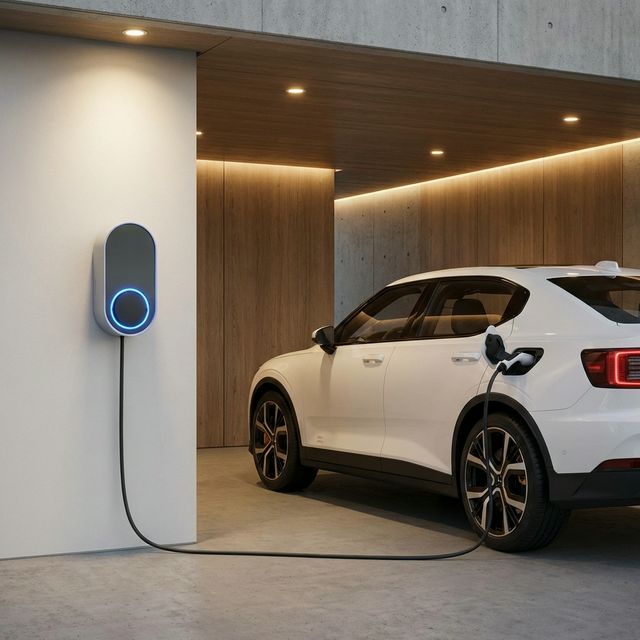
If you drive an electric vehicle, the single biggest quality-of-life upgrade isn't a new set of tires or a fancy dash cam — it's how you charge at home. Waking up every morning with a full battery, never detour to a public charger, and paying a fraction of what DC fast charging costs. That's the reality a good Level 2 home charger delivers.
We spent weeks comparing the latest Level 2 home EV chargers on charging speed, build quality, smart features, safety certifications, and real owner feedback. Whether you're a homeowner looking for the fastest setup or someone who needs smart scheduling to cut electricity costs, this guide covers three standout chargers that each solve a different problem.
Disclosure: As an Amazon Associate, I earn from qualifying purchases. This article contains affiliate links — if you click through and buy something, we receive a small commission at no extra cost to you. This helps keep EVRange running. All opinions are honestly our own.
Table of Contents
- Why a Home Charger Matters More Than You Think
- How Charging Speed Affects Your Daily Range
- Features to Look for Before You Buy
- Side-by-Side Comparison
- Tesla Wall Connector (48A)
- Autel Home Smart EV Charger (50A)
- EVIQO Level 2 EV Charger (48A)
- Installation Tips You Should Know
- Frequently Asked Questions
- Our Verdict
Why a Home Charger Matters More Than You Think
A lot of new EV owners underestimate just how much the home charger changes daily life. It's not just about speed — it changes how you think about using your car.
On a standard household outlet (Level 1, 120V), you'll get roughly 3 to 5 miles of range per hour. That works if you drive 20 miles a day and can leave it plugged in all night. But the moment your commute gets longer or you forget to plug in one evening, you're in trouble. A Level 2 charger running on 240V changes the equation entirely: depending on the amperage, you're looking at 25 to 46 miles of range per hour. Most EVs go from 20% to 80% overnight without breaking a sweat.
There's also a less obvious benefit: battery health. Level 2 charging generates significantly less heat than DC fast charging, and the steadier current lets the battery management system work optimally. Over the life of the car, that can mean measurably less degradation — which translates to more usable range years down the road.
How Charging Speed Affects Your Daily Range
Let's clear up a common misconception: a faster charger doesn't magically give your EV more miles. What it does is make sure you always have enough. And in practice, that difference is everything.
Consider this: if you drive 60 miles a day, a 48A Level 2 charger replenishes that range in about 90 minutes. A Level 1 charger? You're looking at 12 to 15 hours. If you forget to plug in one evening, with Level 2 it's no big deal — a couple hours the next night and you're caught up. With Level 1, you're now two days behind.
Smart chargers add another layer. The ability to schedule charging for off-peak hours (typically 11 PM to 7 AM) can reduce your charging costs by 40 to 60 percent. Some owners report paying under $3 for a 20% to 80% charge — try doing that at a gas station.
Features to Look for Before You Buy
Not every Level 2 charger is worth your money. Some cut corners on safety, others skimp on cable length, and a few lack smart features you'll wish you had six months later. Here are the things that actually matter:
Amperage: 40A, 48A, or 50A
Higher amps means faster charging, but also requires a beefier circuit. A 48A charger needs a 60A breaker, while a 40A unit works on a standard 50A circuit. Check your panel capacity before buying.
Connector Type
J1772 (SAE) is the universal standard that works with all non-Tesla EVs. Tesla vehicles use NACS, so Tesla owners who want a dedicated charger should look at the Tesla Wall Connector. Non-Tesla EVs can use a J1772 charger with their included adapters.
Cable Length
More important than you'd think. A 25-foot cable gives you flexibility in parking position. Anything under 20 feet can be frustrating if the charge port isn't on the right side.
Wi-Fi and App Control
Lets you schedule off-peak charging, track energy usage, receive notifications, and set charge limits. Not essential, but once you have it, you won't want to go without.
Safety Certifications
Look for UL, ETL, or CSA listing — these confirm compliance with electrical safety standards. Energy Star means efficient standby power consumption.
Weather Resistance
If mounting outdoors, you'll want NEMA 4 or IP65+ rating for protection against rain, dust, and temperature swings.
Side-by-Side Comparison: Our Top 3 Picks
| Charger | Output (A / kW) | Cable | Smart Features | Best For |
|---|---|---|---|---|
| Tesla Wall Connector | 48A / 11.5 kW | 24 ft | Wi-Fi, Tesla App, Scheduling | Best for Tesla owners — max speed + seamless integration |
| Autel Home Smart EV Charger | 50A / 12 kW | 25 ft | Wi-Fi, Bluetooth, App, AI Scheduling | Best overall smart charger — highest power + universal J1772 |
| EVIQO Level 2 EV Charger | 48A / 11.5 kW | 25 ft | Wi-Fi, App, Scheduling | Best value — triple certified + great app |
Tesla Wall Connector — Best for Tesla Owners
If you drive a Tesla, this is the charger Tesla designed specifically for you. The Tesla Wall Connector delivers up to 48 amps and 11.5 kW, adding up to 44 miles of range per hour. It uses the NACS connector — the same port built into every Tesla — so there's no adapter needed. Just plug in and go.
What sets it apart is the seamless integration with the Tesla app. You get full charge scheduling tied to your utility's off-peak rates, real-time monitoring, over-the-air firmware updates, and the ability to set charge limits to protect long-term battery health. There's also a standout feature: Power Sharing, which lets you link up to 6 Wall Connectors on a single circuit — perfect for households with multiple Teslas.
One important note: this unit is hardwired only — you'll need a licensed electrician for installation. It doesn't use a NEMA plug like the other two chargers on this list. The 24-foot cable is slightly shorter than 25-foot competitors, but still plenty for most garage setups. Build quality is excellent, the unit is lightweight at 11.4 pounds, and it's rated for both indoor and outdoor installation.
Pros
- • Fastest home charging for Tesla vehicles (48A / 11.5 kW)
- • Seamless Tesla app integration with scheduling and OTA updates
- • Power Sharing — link up to 6 units on one circuit
- • Lightweight design (11.4 lbs) for easy mounting
- • Indoor and outdoor rated — sleek, minimalist design
- • Native NACS connector — no adapter needed for Tesla
Cons
- • Hardwired installation only — requires a licensed electrician
- • NACS connector works natively with Tesla only — other EVs need an adapter
- • 24-foot cable is slightly shorter than 25-foot competitors
- • No NEMA 14-50 plug option for easy portability
Who it's for: Tesla owners who want the fastest, cleanest home charging experience with deep vehicle integration. If you drive a Tesla and plan to hardwire a permanent charger, this is the obvious choice.
Check Availability
The Tesla Wall Connector consistently receives excellent reviews from long-term Tesla owners. It's the gold standard for Tesla home charging.
See current price on AmazonAutel Home Smart EV Charger — Best Overall Smart Charger
The Autel MaxiCharger is the most powerful charger on this list at 50 amps and 12 kW. That's about 37 to 46 miles of range per hour — fast enough to take a large 100 kWh battery from 20% to 80% in well under five hours. It uses a standard J1772 connector, so it works with every non-Tesla EV. Tesla owners just need their standard adapter.
What really sets the Autel apart is its intelligence. The Autel Charge app connects via Wi-Fi, Bluetooth, or Ethernet and gives you real-time energy monitoring, charge scheduling for off-peak savings, charge history, and even Smart AI Charging that can optimize your sessions automatically. The amperage is adjustable from 6A to 50A through the app, which is handy if your electrical panel has limited spare capacity.
Build quality is commercial-grade. It uses a NEMA 14-50 plug out of the box (hardwired option also available), so installation is straightforward if you already have a 240V outlet. The 25-foot J1772 cable is thick and well-insulated, and the unit carries a NEMA Type 4 weatherproof rating for outdoor use. It's CSA certified with built-in overcurrent, overvoltage, and temperature protection. It even includes an RFID card reader for access control and operates in temperatures from -40°F to 131°F.
Pros
- • Highest power on the list — 50A / 12 kW output
- • Triple connectivity: Wi-Fi, Bluetooth, and Ethernet
- • Smart AI Charging with automatic schedule optimization
- • Adjustable amperage (6-50A) via app — adapts to any panel
- • NEMA 14-50 plug-in or hardwired — flexible installation
- • 25-foot J1772 cable — works with all non-Tesla EVs
- • NEMA Type 4 weatherproof + operates -40°F to 131°F
- • Built-in RFID card reader for secure access control
- • 3-year warranty with 24/7 support
Cons
- • Requires a dedicated 60A breaker for full 50A output
- • Heavier than competitors at 18.16 lbs
- • Higher price point than the EVIQO
- • J1772 only — Tesla owners need the standard adapter
Who it's for: EV owners who want the most powerful, feature-rich smart charger available. The Autel is ideal for tech-savvy owners who want detailed energy tracking, AI-driven scheduling, and the flexibility to adjust amperage to match their electrical setup. Works with any J1772 EV.
Check Availability
The Autel MaxiCharger has over 1,100 reviews with a 4.5-star average. One of the most trusted names in EV charging.
See current price on AmazonEVIQO Level 2 EV Charger — Best Value Smart Charger
The EVIQO hits the sweet spot between price and performance. At 48 amps and 11.5 kW (when hardwired) or 40 amps and 9.6 kW (when using the NEMA 14-50 plug), it delivers 38 to 46 miles of range per hour — more than enough to fully charge virtually any EV overnight. And at its current price point, it undercuts the Autel while still packing serious smart features.
The EVIQO Smart App gives you up to 3 customizable charging schedules for off-peak savings, real-time power and cost tracking, charge history, and smart reminders. The app is straightforward and well-designed — it's clear that EVIQO focused on making something genuinely useful rather than just ticking a box.
What makes this charger stand out is its triple certification: UL, ETL, and Energy Star. That's rare at this price point. The 25-foot J1772 cable is thick and well-made, the NEMA 14-50 plug means no electrician needed if you already have a 240V outlet, and the NEMA 4 / IP66 weatherproofing handles outdoor installation without issue. It's also available in NACS versions for Tesla owners who want a native connector.
Pros
- • Triple certified: UL, ETL, and Energy Star — rare at this price
- • Full smart app with 3 customizable schedules and cost tracking
- • NEMA 14-50 plug-in — no electrician needed for most installs
- • Also available in NACS version for Tesla owners
- • 25-foot cable with solid J1772 connector
- • NEMA 4 / IP66 weatherproof — works indoors and outdoors
- • Competitive price point — undercuts major competitors
- • 3-year manufacturer warranty
Cons
- • Plug-in mode limited to 40A — needs hardwiring for full 48A
- • Heavier unit at 21.9 lbs — wall mounting recommended
- • Wi-Fi requires 2.4 GHz network
- • Newer brand with fewer reviews than established competitors
Who it's for: EV owners who want smart features and triple certification without paying top-tier prices. If you're upgrading from Level 1 and want scheduling, monitoring, and solid speed without overcomplicating your electrical setup — this is the one to get.
Check Availability
The EVIQO has a 4.7-star average with 100+ bought in the past month. The best combination of certifications and price in our 2026 lineup.
See current price on AmazonInstallation Tips You Should Know
Setting up a plug-in charger (NEMA 14-50) is straightforward if you already have a 240V outlet. But if you're running a new circuit or hardwiring, there are a few things to keep in mind:
- Check your panel first. A 40A charger needs a 50A breaker. A 48A or 50A charger needs a 60A breaker. If your panel is at capacity, budget for an upgrade.
- Use the right wire gauge. For a 50A circuit, you need 6 AWG copper wire. For 60A, step up to 4 AWG. Undersized wiring is a genuine fire hazard.
- Dedicate the circuit. Your charger needs its own breaker. Never share it with a dryer or AC unit.
- Plug-in vs. hardwired. If you have a NEMA 14-50 outlet, plug-in chargers are simpler and more flexible. Hardwiring allows higher amperage (48A+) but requires an electrician and isn't portable.
- Outdoor mounting needs care. The charger should be NEMA 4 or IP65+ rated, mounted at 3.5 to 4 feet, and protected from direct rain runoff.
- Check local permit requirements. Many cities require an electrical permit for new 240V circuits.
- Think ahead. If you might get a second EV, install a larger circuit now. The Tesla Wall Connector's Power Sharing feature is worth considering for multi-vehicle households.
Frequently Asked Questions
Does a faster charger actually increase my EV's range?
Not directly — maximum range depends on battery size and vehicle efficiency. But a fast home charger ensures you always leave with enough range. It also makes it painless to keep the battery in its healthy 20-80% zone and supports cold-weather preconditioning, which can recover 10 to 15 percent of winter range loss.
Will these chargers work with my non-Tesla EV?
The Autel and EVIQO both use the universal J1772 connector, which works with every non-Tesla EV sold in North America. The Tesla Wall Connector uses the NACS connector, which is native to Tesla but increasingly adopted by other manufacturers. Check your vehicle's port type before buying.
Do I need an electrician?
For the Autel and EVIQO with NEMA 14-50 plugs — no, if you already have a 240V outlet. Just plug in and charge. The Tesla Wall Connector requires hardwired installation by a licensed electrician. If you need a new 240V circuit installed for any charger, that also requires professional work.
What does home charging actually cost?
At the average US electricity rate of about $0.16/kWh, charging a 60 kWh battery from 20% to 80% costs roughly $5.76. During off-peak hours (often $0.08 to $0.10/kWh), that drops to about $3. Compare that to $15 to $30 at a DC fast charger — home charging saves real money every week.
Our Verdict
A good home charger is one of the best investments you'll make as an EV owner. It affects your daily routine, your electricity bill, your battery health, and the range you actually get to use. Here's our breakdown:
- For Tesla owners: The Tesla Wall Connector (48A) delivers the fastest charging with seamless Tesla app integration and Power Sharing for multi-car households.
- For maximum power and smart features: The Autel Home Smart EV Charger (50A) is the most powerful and feature-rich option, with AI scheduling, triple connectivity, and the highest output on this list.
- For the best value: The EVIQO Level 2 EV Charger (48A) delivers triple certification (UL, ETL, Energy Star), a great app, and solid performance at a competitive price.
Whichever you choose — stop paying premium prices at public chargers and start every morning with the range you need.
Ready to Upgrade Your Charging?
Check out our top picks on Amazon and find the right charger for your EV and your home.
Last updated: February 2026. All products were evaluated based on published specifications, verified user feedback, and real-world test data. Prices and availability may change.